

Technical Guide to Thermal Drone Electrical Inspection for Industrial Assets

A single overheating component within a high-voltage substation can lead to catastrophic system failure and extensive unplanned downtime. Whilst traditional ground-based thermography has served as a baseline, it often fails to capture the precision required for complex industrial assets. Adopting a professional thermal drone electrical inspection strategy allows your team to identify critical anomalies from safe distances, significantly reducing the risks associated with manual inspections near live equipment.
You recognise that inconsistent data from handheld devices often leads to misinformed maintenance decisions. This guide provides the technical expertise required to master radiometric accuracy and operational efficiency. We'll examine the mandatory requirements of the 2026 NFPA 70B standard; we also provide a framework for integrating high-resolution data from sensors like the Zenmuse H30T into your asset management systems. By the end of this technical overview, your organisation will have a clear path to reducing operations and maintenance costs whilst ensuring the highest standards of professional accountability.
Key Takeaways
Understand the critical distinction between qualitative thermal imagery and quantitative radiometric data to ensure precise temperature measurement across complex industrial materials.
Evaluate the safety and efficiency advantages of a thermal drone electrical inspection compared to traditional handheld or helicopter-based survey methodologies.
Establish a proactive maintenance programme that utilises high-resolution aerial data to identify potential failures before they result in costly system downtime.
Master the operational workflows required for compliant data capture, including rigorous risk assessments and the technical generation of radiometric orthomosaics.
Learn how thermographic insights integrate with advanced building surveys and 3D modelling to provide a comprehensive overview of industrial asset health.
Table of Contents
The Evolution of Asset Integrity: Why Thermal Drone Electrical Inspection is Essential
The Science of Aerial Thermography: Identifying Critical Electrical Faults
Comparing Inspection Methodologies: Drones vs. Traditional Electrical Surveys
Executing a Compliant Thermal Survey: From Data Capture to Technical Reporting
The Evolution of Asset Integrity: Why Thermal Drone Electrical Inspection is Essential
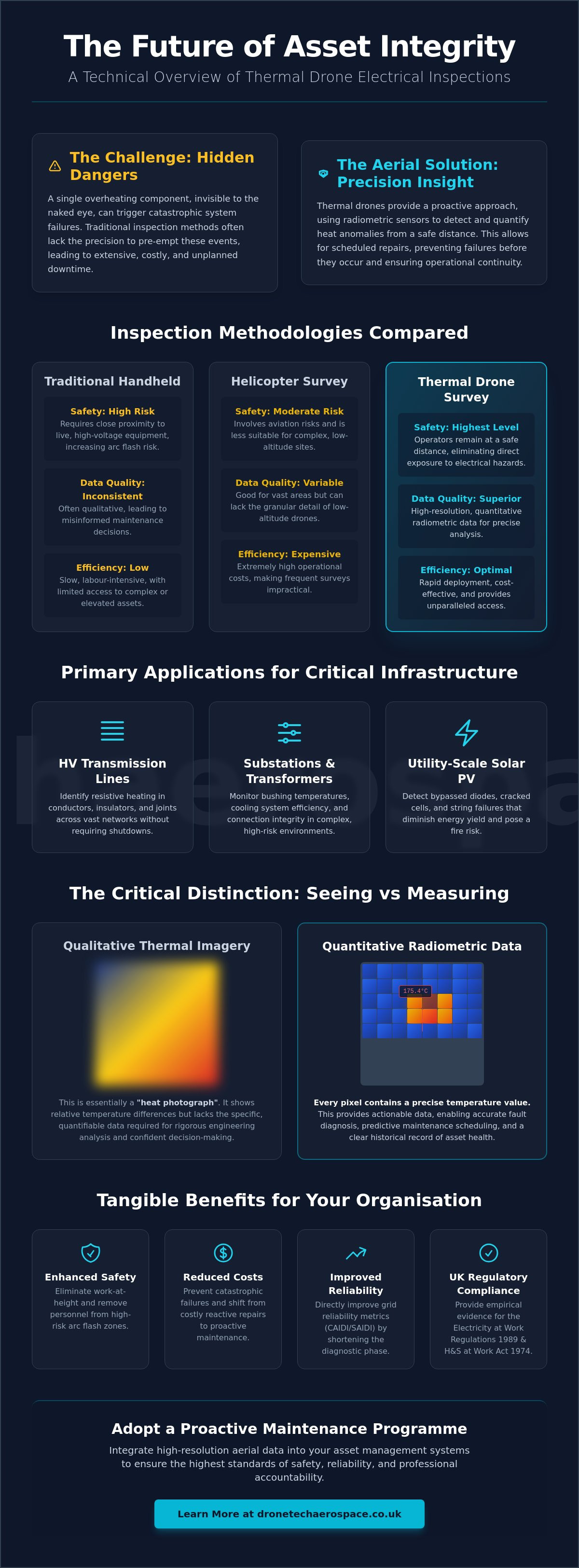
The transition from reactive repair cycles to proactive, data-driven preventative maintenance programmes represents a fundamental shift in industrial asset management. A professional thermal drone electrical inspection utilises UAV-mounted radiometric sensors to detect and quantify anomalous heat signatures that remain invisible to the naked eye. This methodology allows asset managers to move beyond visual checks, providing a technical baseline for the health of critical infrastructure without requiring system shutdowns.
The primary applications for this technology include several high-stakes environments where reliability is non-negotiable:
High-voltage (HV) transmission lines: Identifying resistive heating in conductors and insulators across vast distances.
Substations and transformers: Monitoring bushing temperatures and cooling system efficiency.
Utility-scale solar PV arrays: Detecting bypassed diodes, cracked cells, and string failures that diminish energy yield.
Safety remains the primary driver for adopting aerial thermography. By utilising drones, organisations eliminate the need for personnel to work at height or enter the "flash zone" of live high-voltage components. This separation between the inspector and the asset reduces the risk of arc flash incidents and falls, ensuring that complex surveys are completed with zero physical contact with the infrastructure.
Addressing the Cost of Utility Downtime
Unplanned outages often stem from components that have been degrading for months. Rapidly identifying "hot spots" (localised areas of high resistance) allows for scheduled repairs during low-load periods, preventing the catastrophic failure of transformers or switchgear that could lead to widespread fires. For UK grid operators, the integration of drone-derived data directly improves CAIDI (Customer Average Interruption Duration Index) and SAIDI (System Average Interruption Duration Index) reliability metrics by shortening the diagnostic phase of maintenance.
Thermal anomaly detection in the context of substation maintenance is the precise identification of localised temperature variances that indicate high-resistance connections or impending insulation failure within live electrical components.
Regulatory and Insurance Drivers in the UK
Compliance with the Electricity at Work Regulations 1989 and the Health and Safety at Work Act 1974 requires rigorous, periodic inspection of electrical systems. A comprehensive Thermographic inspection provides the empirical evidence required to satisfy these statutory obligations whilst identifying hidden vulnerabilities. This documentation is essential for maintaining DSEAR (Dangerous Substances and Explosive Atmospheres Regulations) compliance in hazardous environments where electrical faults could act as ignition sources.
From a financial perspective, precision thermal data supports a drone loss adjuster inspection by providing a clear historical record of asset health. Insurance providers increasingly recognise these surveys as a standard for risk mitigation; they often require proof of regular thermographic monitoring to maintain coverage for high-value industrial sites. This data-driven approach ensures that liability is managed with the same level of precision as the technical operation itself.
The Science of Aerial Thermography: Identifying Critical Electrical Faults
Achieving industrial-grade accuracy during a thermal drone electrical inspection requires a sophisticated understanding of radiometric data. Whilst standard thermal cameras produce a visual heat map, radiometric sensors record the specific temperature value for every pixel in the frame. This distinction is critical for asset managers who require quantifiable evidence of component degradation rather than mere qualitative observations. Data collected without radiometric calibration is essentially a photograph of heat; it lacks the empirical depth needed for rigorous engineering analysis.
The challenge of emissivity must be addressed to ensure data integrity. Different materials used in electrical infrastructure, such as copper busbars, aluminium conductors, and ceramic insulators, radiate infrared energy at varying efficiencies. A polished aluminium surface may appear cooler than a weathered ceramic component despite being at the same temperature. Correcting for these material-specific properties, alongside environmental variables like wind speed and solar loading, is essential. High winds can cause convective cooling that masks an underlying fault, whilst solar loading can create false positives through thermal reflection.
Industry professionals rely on Delta T (ΔT) criteria to classify fault severity. This method involves measuring the temperature rise of a suspect component against a reference point, such as a similar component under the same load or the ambient air temperature. Ongoing research into automated drone inspection protocols highlights the importance of these standardised metrics for maintaining grid stability. For organisations requiring this level of technical rigour, engaging a specialist for professional thermographic surveys ensures that all data is captured and analysed to industrial standards.
Common Electrical Anomalies Detected
Modern thermography identifies several critical failure modes that often precede system failure. Loose or corroded connections manifest as high-resistance points, typically appearing as localised "hot spots" on busbars and terminators. Overloaded circuits are identified by visualising unbalanced thermal loads across three-phase systems. Additionally, failing insulators are detected by spotting tracking or leakage currents on HV string insulators. These anomalies, if left unaddressed, represent significant fire and reliability risks to the wider network.
Sensor Specifications for Industrial Precision
To maintain professional standards for a thermal drone electrical inspection, a sensor resolution of at least 640x512 is the minimum requirement. This level of detail allows for the identification of small components from a safe standoff distance, preserving both the equipment and the safety of the flight team. High refresh rates, specifically 30Hz or greater, are necessary to capture stable data whilst the UAV is in motion. Integrating these thermal sensors with high-resolution RGB cameras allows for simultaneous visual and infrared fault verification. This dual-sensor approach ensures that every thermal anomaly is cross-referenced with its physical condition, such as visible corrosion or bird nesting, providing a complete diagnostic picture.
Comparing Inspection Methodologies: Drones vs. Traditional Electrical Surveys
Traditional inspection methodologies, whilst historically adequate, possess inherent limitations that professional aerial solutions now resolve. Ground-based surveys using handheld thermographic cameras frequently suffer from restricted lines of sight; technicians often cannot view the tops of transformers or the upper side of insulators. This lack of perspective can hide critical faults that only become visible from an elevated nadir or oblique angle. By contrast, a thermal drone electrical inspection provides a comprehensive 360-degree view of the infrastructure, ensuring that no anomalous heat signature is overlooked due to physical obstruction.
Operational continuity is perhaps the most significant advantage for heavy industry. Drone surveys are performed whilst the plant remains fully live and operational, eliminating the massive financial losses associated with scheduled shutdowns for manual inspections. Whilst manned aviation, such as helicopter surveys, offers speed, it introduces high fuel costs, significant noise pollution, and a lack of granular flexibility. Drones operate at a lower altitude and slower speed, which results in a much higher data density. A single flight can capture thousands of georeferenced radiometric data points, providing a level of detail that neither ground crews nor helicopters can match.
Aerial vs. Handheld Thermography
The field-of-view provided by UAV platforms is superior for inspecting complex substation layouts. Aerial sensors maintain a safe "air gap" of several metres whilst using high-magnification radiometric lenses to achieve sub-centimetre resolution. This distance is a critical safety buffer that handheld operators cannot always maintain when navigating tight ground-level spaces near live conductors. In terms of efficiency, a drone team can inspect up to 10km of powerlines per day; conversely, a traditional foot patrol typically covers only 1-2km in the same period. This five-fold increase in productivity directly reduces the per-asset cost of inspection programmes.
Integrating Thermal Data into BIM and Digital Twins
Modern asset management requires more than just a gallery of images. Integrating thermal data into a broader industrial drone inspection strategy allows for the creation of radiometric orthomosaics. These are high-resolution, georeferenced maps where every pixel contains temperature data. By overlaying this information onto 3D models or BIM (Building Information Modelling) environments, engineers can precisely geolocate faults within a digital twin of the facility. This approach enables time-series analysis, allowing maintenance teams to track the degradation of a specific component over several years and predict failure with mathematical precision.
Executing a Compliant Thermal Survey: From Data Capture to Technical Reporting
Execution is the phase where technical theory meets industrial reality. Before any UAV is deployed, a rigorous pre-flight planning phase is mandatory, encompassing site-specific risk assessments (SSRA) and the verification of airspace authorisations through the Civil Aviation Authority (CAA). Weather monitoring is equally critical; surveys must be conducted during appropriate load conditions and outside of periods with high solar loading or excessive wind speeds that could skew radiometric readings. These variables are managed with absolute precision to ensure the reliability of the final data set.
During the flight, maintaining a consistent altitude and precise overlap (typically 80% frontal and side) is essential for generating a radiometric orthomosaic. This methodical approach ensures that every component is viewed from multiple angles, eliminating blind spots caused by structural geometry. Post-flight data processing then uses specialised software to apply atmospheric corrections. These corrections factor in humidity and distance to the target, ensuring the temperatures recorded during the thermal drone electrical inspection are accurate to within industrial tolerances (typically ±2°C or 2% of the reading). For industrial clients requiring this level of technical rigour, our professional thermal drone surveys deliver the compliant documentation needed for complex insurance and safety audits.
The Anatomy of a Professional Thermal Report
A professional thermal report translates raw data into actionable maintenance intelligence. We utilise the Delta T (ΔT) method to categorise faults into severity levels, prioritising urgent Level 1 repairs that require immediate intervention over Level 3 anomalies that merely require ongoing monitoring. Every identified fault is presented with side-by-side visual (RGB) and thermal (IR) evidence. This allows maintenance teams to cross-reference physical conditions, such as visible corrosion or loose hardware, with the thermal signature. Furthermore, every anomaly is georeferenced with GPS coordinates and asset tags, facilitating seamless integration into existing maintenance work orders and asset management software.
Quality Assurance and Standards
The integrity of a thermal survey depends entirely on the expertise of the analyst. It's a requirement that data analysis is performed by ITC (Infrared Training Centre) Level 2 or 3 certified thermographers who understand the complex physics of infrared radiation. This level of certification ensures that the survey remains compliant with RICS (Royal Institution of Chartered Surveyors) and UK Thermography Authority guidelines. Raw thermal images are insufficient for insurance-grade reports because they lack the necessary radiometric calibration, atmospheric compensation, and expert interpretation required to prove technical liability or satisfy DSEAR requirements. Adhering to these high standards provides the professional accountability that corporate stakeholders and insurers demand.
Strategic Asset Management with Drone Tech Aerospace
Drone Tech Aerospace operates as a high-performance partner for industrial and utility stakeholders requiring superior technical prowess. Our approach to thermal drone electrical inspection is built upon a decade of operational experience within the most demanding UK environments. We recognise that precision is the only metric that matters in high-voltage environments; consequently, we utilise only state-of-the-art radiometric sensors that provide the technical depth required for absolute professional accountability. Our UK-wide deployment capability ensures that large-scale infrastructure projects are serviced with consistent standards of reliability and precision.
Our capabilities extend beyond simple data capture. We specialise in the seamless integration of thermographic data into wider asset management frameworks, which often involves aligning thermal insights with advanced drone building survey workflows. By combining 3D modelling with radiometric orthomosaics, we provide a holistic view of asset integrity that supports both renewable energy solar farms and heavy industrial complexes. This multi-layered data structure ensures that every thermal anomaly is understood within its specific structural context, allowing for more accurate diagnostic conclusions.
Partnering for Long-Term Reliability
Reliability is achieved through consistency rather than isolated interventions. We work with our clients to establish recurring inspection schedules, allowing for the longitudinal tracking of asset health over several years. This time-series data is essential for identifying subtle degradation patterns that a single survey might overlook. To facilitate this, we provide proprietary data delivery platforms that simplify the review process for stakeholders, ensuring that technical findings are immediately accessible to maintenance teams. Our experts also provide consultancy on remediation strategies, helping you prioritise capital expenditure based on empirical thermographic evidence.
Request a Technical Consultation
Engaging our services begins with a site-specific inspection plan tailored to your precise operational requirements. Whether you manage a single substation or a national-scale asset portfolio, our team provides the logistical and technical expertise required for comprehensive audits. We handle all aspects of the operation, from CAA permissions to final technical reporting, ensuring a seamless experience for your internal teams. Contact Drone Tech Aerospace today to discuss your thermal drone electrical inspection requirements and secure the long-term integrity of your industrial assets.
Optimising Industrial Reliability through Aerial Thermography
The transition to aerial thermography is no longer a matter of convenience; it's a strategic necessity for maintaining complex high-voltage infrastructure. By leveraging a professional thermal drone electrical inspection, asset managers gain access to high-fidelity radiometric data that identifies resistive heating and component degradation with absolute precision. This methodology eliminates the safety risks inherent in manual inspections whilst ensuring operational continuity across utility-scale networks. Integrating these insights into digital twins and BIM environments provides the predictive power required to prevent catastrophic failures before they occur.
Drone Tech Aerospace provides the technical leadership required for these high-stakes environments. Our ITC Level 3 Certified Thermographers and 10 years of industrial experience ensure that every survey meets the highest standards of professional accountability. With our UK-wide operational capability, we are positioned to deliver bespoke inspection frameworks for your most critical assets. Request a Professional Thermal Drone Inspection Proposal to secure your facility's long-term integrity. We look forward to supporting your transition to a data-driven maintenance programme.
Frequently Asked Questions
How accurate is a thermal drone electrical inspection compared to manual methods?
A professional thermal drone electrical inspection is often more accurate than manual methods because it captures nadir (top-down) views that ground-based technicians cannot access. Modern radiometric sensors provide a specific temperature value for every pixel in the frame, allowing for precise measurements within industrial tolerances of ±2°C. This high-resolution data ensures that subtle anomalies are quantified with empirical rigour rather than merely observed from restricted ground angles.
Do I need to shut down my electrical plant during a thermal drone survey?
No, shutdowns are not required; in fact, a thermal survey is most effective when the system is under a minimum of 40% electrical load. This allows the sensors to detect the heat generated by resistance or component failure whilst the plant remains fully operational. Conducting inspections during normal or peak load periods provides the most accurate diagnostic picture of asset health without disrupting your production cycles.
What is the Delta T (ΔT) method in electrical thermography?
The Delta T method involves calculating the temperature difference between a suspect component and a reference component, such as a similar phase under an identical load or the ambient air temperature. This temperature rise is used to categorise the severity of the fault according to industry standards. Level 1 faults indicate a critical risk requiring immediate intervention, whilst Level 3 anomalies are noted for continued monitoring during future inspection cycles.
Can thermal drones detect faults in underground electrical cables?
Thermal drones are primarily designed for the inspection of above-ground assets and cannot directly detect faults in deeply buried underground cables. The surrounding soil typically acts as a thermal insulator, preventing heat signatures from reaching the surface in most industrial configurations. However, these systems remain highly effective for inspecting transition points, cable terminations, and surface-level junction boxes where heat can dissipate into the air.
What weather conditions are required for a successful thermal drone survey?
Successful surveys require dry conditions with wind speeds typically below 10mph to prevent convective cooling from masking underlying faults. Ideal data collection occurs during overcast conditions or at dawn to minimise "solar loading" and thermal reflections from metallic surfaces like aluminium busbars. These specific constraints ensure that the recorded temperature data reflects the internal state of the component rather than external environmental interference.
What qualifications should a drone thermographer hold in the UK?
In the UK, drone thermographers should hold ITC (Infrared Training Centre) Level 2 or 3 certification to ensure they possess the technical knowledge required for complex radiometric data analysis. Additionally, pilots must hold valid Civil Aviation Authority (CAA) authorisations, such as a GVC (General Visual Line of Sight Certificate). Adherence to RICS and UK Thermography Authority guidelines is also essential for maintaining professional accountability in industrial reporting.
How long does it take to receive the final thermal inspection report?
The final technical report is typically delivered within three to five business days following the completion of site-wide data capture. This timeframe allows for the rigorous post-processing of radiometric data and expert analysis by certified thermographers. Rapid delivery of actionable intelligence ensures that your maintenance teams can address critical faults identified during the thermal drone electrical inspection before they escalate into costly system failures.
Is thermal drone data acceptable for industrial insurance claims?
Professional thermal data is widely accepted by industrial insurers, provided the survey is conducted by certified personnel according to recognised standards like the 2026 edition of NFPA 70B. High-resolution radiometric reports provide the empirical evidence of risk mitigation that insurers require to maintain coverage for high-value assets. This documentation is also essential for satisfying statutory safety regulations and providing a clear audit trail for internal compliance.


Comments