

Thermal Wind Turbine Inspection: A Technical Guide to Subsurface Blade Analysis

A flawless external surface on a turbine blade frequently conceals internal delamination or moisture ingress that remains invisible to standard high-resolution visual cameras. For asset managers, relying solely on surface-level data creates a significant blind spot in structural integrity, especially when considering the extreme mechanical stresses of offshore environments. A professional thermal wind turbine inspection is the only non-destructive method capable of detecting these subsurface "silent killers" at scale whilst maintaining operational safety.
You likely recognise that traditional rope-access methods are both prohibitively slow and pose unnecessary safety risks to personnel. This technical guide demonstrates how advanced thermographic UAV surveys provide the high-resolution data required for a robust preventative maintenance strategy. We'll examine the integration of next-generation sensors (including the Teledyne FLIR Boson SX8), the identification of subsurface anomalies, and the systematic reduction of operational risk through precise asset health monitoring.
Key Takeaways
Understand the technical limitations of visual-only assessments and why thermography is the essential non-destructive testing (NDT) method for identifying internal structural anomalies.
Learn the specific hardware requirements for a professional thermal wind turbine inspection, focusing on radiometric sensor resolution and the critical role of material emissivity.
Discover the flight planning protocols required to achieve 100% blade coverage, ensuring that all four surfaces are analysed for subsurface delamination and moisture ingress.
Gain insights into converting complex radiometric data into prioritised defect status maps (Red, Amber, Green) to optimise maintenance scheduling and resource allocation.
Identify how the integration of AI-assisted analysis and long-term health monitoring reduces operational risk whilst preventing catastrophic failures across wind farm portfolios.
Table of Contents
The Role of Thermography in Modern Wind Turbine Asset Integrity
Aerial thermography represents a sophisticated advancement in the field of non-contact, non-destructive testing (NDT), providing a level of structural insight that traditional methods simply cannot replicate. A professional thermal wind turbine inspection utilises high-resolution radiometric sensors to detect subtle thermal gradients across the blade surface, identifying internal anomalies that are invisible to the naked eye. This process relies on the principles of Thermographic inspection, where heat transfer through the composite layers reveals the presence of subsurface flaws. By 2026, the wind industry has largely transitioned from reactive maintenance models to proactive thermal monitoring, recognising that internal integrity is the primary driver of long-term asset health.
The primary advantage of this technology lies in its ability to see through the surface. Whilst visual inspections are essential for identifying external erosion or lightning strikes, they offer no data regarding the internal bond lines or the structural core of the blade. Incorporating a thermal wind turbine inspection into the annual maintenance schedule bridges this gap, allowing operators to identify "silent killers" such as delamination, moisture ingress, or manufacturing defects before they lead to catastrophic failure. This shift towards data-driven maintenance ensures that wind farm operators can maintain peak performance whilst significantly reducing the risk of unscheduled downtime.
Visual vs. Thermal: Bridging the Information Gap
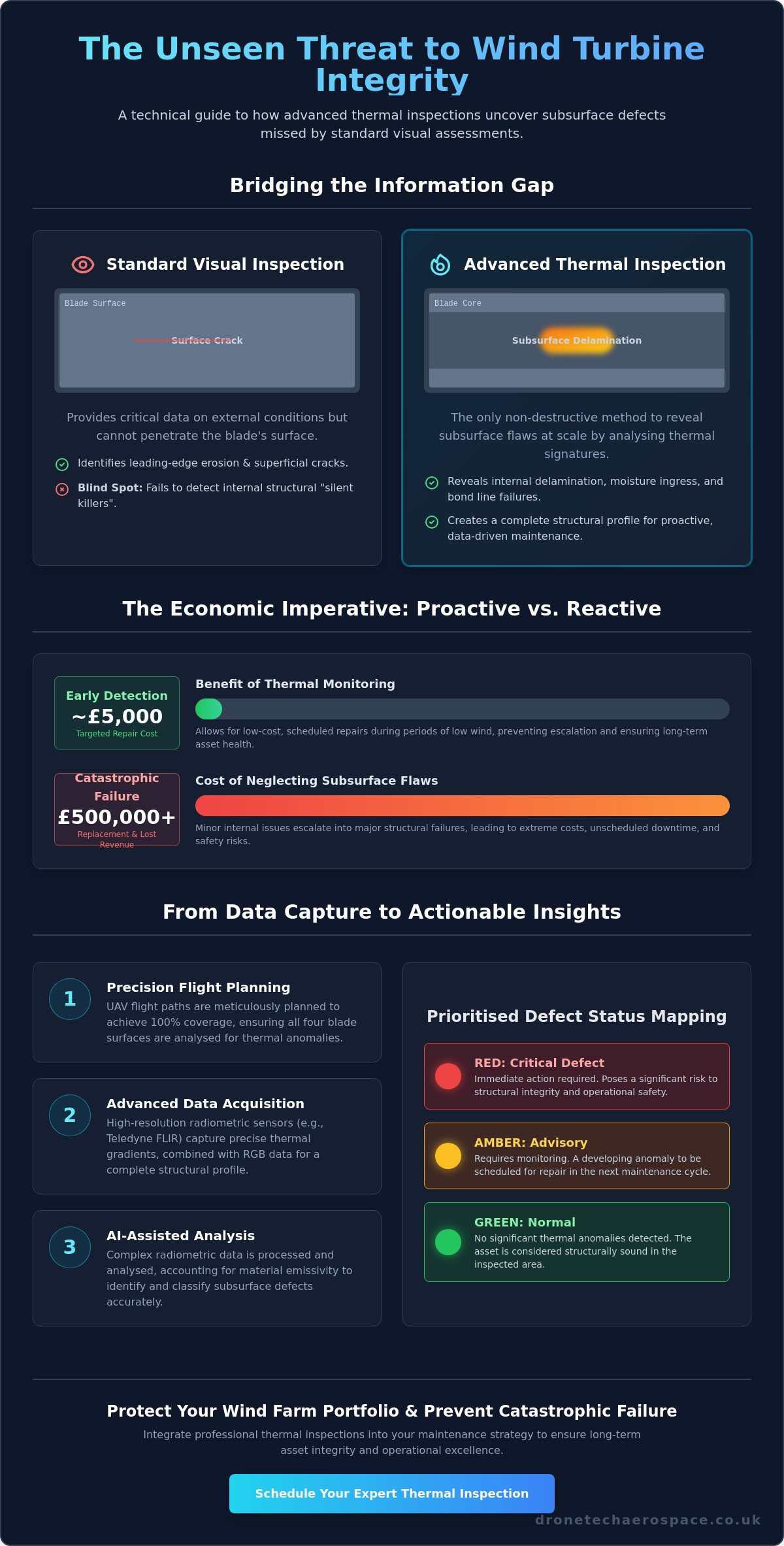
Standard visual drones are highly effective at documenting surface-level degradation, including leading-edge erosion and superficial gel coat cracks. However, these visual cues often fail to reflect the true state of the internal composite structure. Thermal sensors penetrate this information barrier by detecting density changes and voids within the blade material. When a blade is heated by solar radiation and then begins to cool, areas with internal defects retain heat differently than solid sections. By combining high-resolution RGB imagery with radiometric infrared data, technical teams create a holistic "digital twin" of the blade. This dual-layered approach provides a complete structural profile, ensuring that no defect remains hidden beneath the surface.
The Economic Case for Thermal Inspection
The financial justification for integrating thermography into a maintenance strategy is clear and quantifiable. Detecting a minor internal delamination early allows for a targeted, low-cost repair (often costing around £5,000) that can be scheduled during periods of low wind. If left unaddressed, these subsurface flaws often escalate into major structural failures, potentially costing upwards of £500,000 in replacement parts and lost revenue. Beyond direct repair costs, the use of UAVs for these inspections eliminates the reliance on expensive and high-risk rope access teams, who are limited by both weather conditions and physical reach. Asset managers who utilise regular thermal surveys often benefit from more favourable insurance premiums and higher asset valuations. They can demonstrate a rigorous and documented approach to long-term structural integrity, which is essential for maintaining the confidence of stakeholders and investors.
Identifying Subsurface Defects: The Thermal Signatures of Failure
Interpreting thermal data requires a deep understanding of thermodynamics and material science. A thermal wind turbine inspection is not merely about capturing images; it involves analysing how heat flows through complex composite structures. Emissivity is a critical variable. Wind turbine blades, typically constructed from glass-reinforced plastic (GRP) or carbon fibre, possess specific emissivity values that must be precisely calibrated within the radiometric sensor. Failure to account for these material properties can lead to false positives or, more dangerously, the omission of critical structural anomalies.
Technical analysis focuses on identifying thermal gradients that deviate from the expected norm. We distinguish between "hot spots" and "cool spots" based on the timing of the survey and the nature of the defect. For instance, electrical faults in lightning protection systems (LPS) generate their own heat through resistance, appearing as intense hot spots. Conversely, structural anomalies are often detected via passive thermography inspection, where we rely on natural solar heating to reveal internal variations. Identifying bonding failures between the spar cap and the blade skin is a priority, as these represent a fundamental loss of structural capacity that precedes total component failure.
Delamination and Internal Voids
Delamination occurs when the internal layers of the laminate separate, creating air-filled voids. Because air acts as a thermal insulator, it disrupts the conductive heat path from the blade surface to the internal structure. During the heating phase of the day, the surface laminate above a delamination will reach a higher temperature than the surrounding bonded areas because the heat cannot dissipate into the core. These anomalies appear as distinct thermal "shadows" on the sensor. These defects are frequently invisible to 4K visual cameras because the surface gel coat remains perfectly intact whilst the structural integrity beneath is compromised.
Moisture Ingress and Core Degradation
Moisture is a significant threat to the longevity of balsa or foam-core blades. Water acts as a heat sink, possessing a much higher thermal capacity than the dry core material. This creates a noticeable thermal lag during the diurnal cycle. As the ambient temperature drops in the evening, moisture-affected areas retain heat for longer, appearing as "warm" anomalies against the cooling blade skin. Identifying these areas is vital to prevent internal rot and the destructive effects of freeze-thaw cycles, which can rapidly expand internal cracks. For organisations managing extensive portfolios, our specialised Wind Turbine Drone Inspections provide the technical precision required to identify these signatures at scale.
Methodology: Executing a Professional Aerial Thermal Survey
Executing a thermal wind turbine inspection requires a rigorous selection of hardware and a precise flight methodology to ensure data validity. At a minimum, the UAV platform must be equipped with a radiometric thermal sensor featuring a resolution of 640x512 pixels. However, the 2026 industry standard has shifted towards higher-fidelity modules, such as the Teledyne FLIR Boson SX8, which provides 1280x1024 resolution. This fourfold increase in pixel density allows for the detection of significantly smaller anomalies from a safer standoff distance. The drone must maintain a flight path that guarantees 100% blade coverage, capturing imagery from all four sides (pressure side, suction side, leading edge, and trailing edge) to provide a complete structural assessment.
Managing the "Solar Loading" effect is perhaps the most critical technical challenge during data capture. Passive thermography relies on the sun to provide the thermal energy required to highlight internal density variations. There is a specific operational window, typically following several hours of direct solar exposure, when the temperature difference (Delta-T) between the solid laminate and an internal void is most pronounced. Surveys conducted outside this window, or during periods of inconsistent cloud cover, risk producing flat thermal profiles where defects remain hidden. Our pilots monitor real-time irradiance levels to ensure the blade has reached the necessary thermal equilibrium before commencing the survey.
Environmental Constraints and Timing
The success of a thermal wind turbine inspection is heavily dictated by the volatile weather windows common in the UK. High wind speeds, whilst ideal for energy production, create significant turbulence near the nacelle and can cause blade oscillation that blurs thermal data. Furthermore, high wind speeds increase convective cooling on the blade surface, which can "wash out" the subtle thermal signatures of subsurface defects. We plan inspections around specific meteorological criteria, requiring a minimum Delta-T of 2 to 5 degrees Celsius between the defect and the healthy structure. In 2026, our scheduling systems integrate hyper-local weather modelling to exploit narrow windows of low wind and high solar loading, ensuring optimal data contrast.
Sensor Calibration and Ground Sample Distance (GSD)
Achieving the required millimetre-per-pixel resolution is a function of the sensor's focal length and the UAV's distance from the blade. We calculate the Ground Sample Distance (GSD) to ensure that even the smallest internal bond line fractures are captured. A professional survey typically targets a GSD of less than 5mm per pixel. Equally important is the sensor's Thermal Sensitivity, measured as Noise Equivalent Temperature Difference (NETD). Sensors with an NETD of <50mK are utilised to distinguish the minute temperature variations associated with deep-seated delamination. All data is captured in a raw radiometric format, allowing our analysts to adjust emissivity and reflected temperature settings during post-flight processing for absolute accuracy.
Safety remains the primary operational priority. Operating a high-specification UAV in close proximity to the nacelle and hub requires advanced collision avoidance systems and strict adherence to the Health and Safety at Work etc. Act 1974. Our flight teams operate under stringent internal protocols that exceed standard CAA requirements, particularly when navigating the complex aerodynamic wakes generated by the turbine structure itself.
Data Interpretation and Predictive Maintenance Integration
The value of a professional thermal wind turbine inspection is realised during the post-flight analytical phase, where raw radiometric data is transformed into actionable engineering intelligence. Raw infrared imagery alone lacks the context required for maintenance prioritisation. We utilise advanced software to process these datasets, categorising every identified anomaly into a standardised Red, Amber, Green (RAG) status hierarchy. This systematic approach ensures that critical structural threats receive immediate attention whilst minor defects are monitored for future progression, preventing the escalation of repair costs.
By 2026, AI-assisted analysis has become a cornerstone of fleet-wide asset management. These algorithms can reduce data processing time from several weeks to just a few hours, achieving defect detection accuracy rates exceeding 95% (based on current industry benchmarks). This technology allows operators to identify recurring patterns across entire wind farm portfolios, such as systemic manufacturing flaws in specific blade batches or consistent wear patterns in certain geographic orientations. Integrating these thermal findings into a broader industrial drone inspection strategy enables a transition from periodic checks to a truly predictive maintenance model.
From Thermal Image to Engineering Report
An effective report must provide more than just imagery; it requires precise spatial context. We tag every anomaly with exact GPS coordinates and blade-station measurements (the distance from the hub) to guide repair teams with absolute accuracy. Thermal orthomosaics are generated to provide a continuous, high-resolution map of the entire blade surface. This level of detail allows for delta analysis, where current data is compared against historical surveys to track the exact rate of defect expansion or moisture migration over time. This longitudinal tracking is essential for justifying repair schedules to stakeholders and insurers.
BIM and Digital Twin Synchronisation
Modern asset integrity workflows increasingly rely on the synchronisation of thermal data with 3D models. These datasets feed directly into advanced drone building survey frameworks used for creating high-fidelity digital twins. By overlaying thermal signatures onto a 3D structural model, engineers can simulate how internal voids or delaminations impact aerodynamic efficiency and structural load distribution. This automation allows for the triggering of maintenance alerts the moment a thermal threshold is breached, ensuring that intervention occurs at the optimal point in the asset's lifecycle. To secure the long-term health of your offshore or onshore assets, contact our team to discuss a bespoke thermal wind turbine inspection programme.
Drone Tech Aerospace: Expert Thermal Inspection for UK Wind Assets
Drone Tech Aerospace operates as a specialist industrial partner, providing comprehensive national coverage for both onshore and offshore wind farms across the United Kingdom. Our operational capacity is designed to meet the rigorous demands of utility-scale energy providers, ensuring that every thermal wind turbine inspection is executed with absolute technical precision. We deploy high-specification radiometric sensors that exceed standard industry requirements, enabling the detection of minute structural variances that less specialised providers frequently overlook. This hardware is supported by proprietary analysis methods developed through years of experience in the heavy industrial and civil engineering sectors.
Our flight teams consist of highly experienced UAV pilots and certified thermographers who understand the complexities of wind turbine architecture. We don't merely deliver raw data; we provide sophisticated, decision-ready intelligence. Our reporting structures are specifically designed to satisfy the stringent documentation requirements of UK insurance providers and original equipment manufacturer (OEM) warranty departments. By providing a transparent and verifiable audit trail of internal blade health, we assist asset managers in maintaining compliance and securing the long-term financial viability of their energy portfolios.
Why a Professional Partner Matters
The risks associated with utilising consumer-grade thermal equipment or inexperienced operators for industrial assets are substantial. Standard thermal cameras often lack the radiometric accuracy and thermal sensitivity (NETD) required to distinguish between harmless surface temperature variations and genuine structural delamination. Furthermore, operating in the complex aerodynamic environments surrounding turbine nacelles requires a level of pilot proficiency that only comes with industrial-scale experience. We adhere strictly to all CAA regulations and internal safety protocols that mirror the high standards of the sectors we serve. Our commitment to high-precision data ensures that your maintenance decisions are based on facts, not approximations, thereby significantly reducing operational risk.
Secure Your Assets for 2026 and Beyond
As the UK's wind infrastructure ages, the implementation of robust life extension (LEX) programmes becomes critical. Our thermal surveys provide the longitudinal data necessary to justify extending the operational life of assets beyond their original design parameters. We work closely with asset owners to develop tailored inspection schedules that align with specific fleet requirements and geographic challenges. Whether managing a single onshore site or a massive offshore array, our systematic approach to data collection and interpretation remains consistent. To discuss the technical requirements of your next portfolio survey or to learn more about our methodology, Contact Drone Tech Aerospace for a professional consultation.
Optimising Asset Longevity Through Subsurface Intelligence
Integrating advanced thermography into an asset management strategy isn't merely an option for operators seeking to mitigate high-value risks. Subsurface anomalies, such as internal delamination and moisture ingress, require specialised radiometric sensors and precise environmental timing to be identified accurately. A professional thermal wind turbine inspection provides the empirical evidence needed to shift from reactive repairs to a data-driven, predictive maintenance model.
Drone Tech Aerospace provides a national UK operational footprint, delivering ISO-certified thermal data analysis for the most demanding onshore and offshore environments. Our teams utilise specialised sensors with <50mK thermal sensitivity, ensuring that even the most subtle internal structural variations are documented with absolute clarity. Precision is non-negotiable for warranty compliance. It's also vital for securing the long-term integrity of your energy assets. Request a Technical Consultation for Your Wind Farm Inspection to discuss your specific fleet requirements. We look forward to supporting your transition towards a more resilient and profitable maintenance framework.
Frequently Asked Questions
How does thermal wind turbine inspection differ from visual drone surveys?
Thermal wind turbine inspection identifies internal density variations and subsurface anomalies rather than surface-level degradation. Whilst visual cameras document erosion, leading-edge damage, and lightning strikes, thermal sensors detect delamination and internal voids within the composite layers. This provides a three-dimensional understanding of asset integrity, allowing engineers to address structural "silent killers" that remain invisible to standard high-resolution RGB sensors.
What is the best time of day to conduct a thermal blade inspection?
The optimal window for a professional survey occurs when the blade has achieved thermal equilibrium through solar loading. This typically falls between 10:00 and 14:00, provided there is consistent solar irradiance. For moisture detection, the cooling phase in the late evening is often superior, as water-saturated sections retain heat longer than dry composite materials, creating a distinct and measurable thermal signature.
Can thermal drones detect moisture inside a wind turbine blade?
Thermal drones are highly effective at detecting moisture ingress within balsa or foam-core blades. Water possesses a significantly higher thermal capacity than composite laminate, causing it to act as a heat sink. During the evening cooling cycle, moisture-affected areas appear as "warm" anomalies against the rapidly cooling healthy structure. This allows for the identification of internal rot before it compromises the blade's structural capacity.
What resolution is required for a professional thermal turbine survey?
A professional survey requires a minimum radiometric resolution of 640x512 pixels to ensure sufficient data density. In 2026, industry leaders have adopted 1280x1024 sensors, such as the Teledyne FLIR Boson SX8, to achieve a Ground Sample Distance (GSD) of less than 5mm per pixel. High resolution is essential for distinguishing the subtle temperature gradients associated with deep-seated delamination or complex bond line failures.
Is thermal data accepted by insurance companies for wind farm claims?
Radiometric thermal data is widely accepted by UK insurance and warranty providers, provided the survey is conducted by certified thermographers using calibrated equipment. High-fidelity thermal reports provide a verifiable audit trail of an asset's internal health, which is often mandatory for significant claims or life extension (LEX) programmes. Our documentation meets these stringent industrial standards, offering the technical assurance required for corporate risk assessments.
How often should thermal inspections be carried out on wind turbines?
Standard industry practice suggests a baseline thermal inspection every two to three years for healthy assets. However, more frequent surveys are recommended for offshore fleets or immediately following significant weather events, such as lightning strikes. Integrating a thermal wind turbine inspection into a biennial maintenance cycle ensures that internal defects are identified and categorised before they escalate into catastrophic failures or require expensive component replacements.
What are the main weather constraints for aerial thermal surveys in the UK?
The primary constraints in the UK include excessive wind speeds and inconsistent cloud cover. High winds cause convective cooling on the blade surface, which can "wash out" subtle thermal signatures. Additionally, rapid changes in solar irradiance due to cloud movement disrupt the thermal equilibrium required for passive thermography. We monitor hyper-local meteorological data to exploit narrow windows of low wind and high solar loading for optimal results.
How does solar loading affect the accuracy of thermal blade data?
Solar loading is the fundamental energy source for passive thermography, creating the temperature differential (Delta-T) required to highlight internal defects. Without sufficient solar exposure, the heat flow through the composite layers is too uniform to reveal subsurface voids. A minimum Delta-T of 2 to 5 degrees Celsius is typically required between the defect and the healthy laminate to produce a high-contrast, actionable thermal map.


Comments